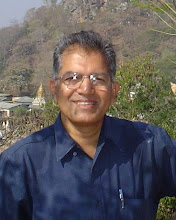
Just went through - went through is the right word, I went through it without really pausing, slowing down, attempting to digest - McShane's proposal for a new book, with the title Bernard Lonergan's View of Physics, Economics and History: A Heuristic Gauging Structure for Human Ecological Survival. McShane received a rather encouraging reply from his prospective publishers just as he was setting out for the airport to come to India, and so forwarded the mail to me, with a request for a printout, and an invitation to read on if I could. I did. Impressive.
Impressive first of all because, while there is much Philtalk, there is much less of it than is usual. On the whole the proposal reads beautifully, and does communicate without too much unexpected (Joycean) jargon.
What is Phil trying to do? "To break through to a heuristic of history" by drawing on and then expanding Lonergan's writings. The expanding will involve creative integration from the two sciences that were Lonergan's greatest interest: physics and economics, the one a natural science and the other a human science.
More specifically, the project intends to follow Lonergan's advice to select "the conspicuously successful science of our time" - which is physics, and to use it to lift up the conspicuously unsuccessful science - which Phil identifies with economics. And all this, in the service of working out "an integral heuristic of history." Thus: "The writings of O'Raifeartaigh are key here: can I lift O'Raifeartaigh's work, both in physics and in the heuristics of dialectic, to a level where I can identify, heuristically and effectively, a future dynamics of both physics and economics that I discern in the history of macro-hydrodynamics[,] a history which powerfully nudges us to conceive of a beginning of ecologically-responsible economic dynamics?"
Economics as a non-science is, I think, one of the claims made by Lonergan and pushed by McShane in many of his works, including the recent issue of Divyadaan: Journal of Philosophy and Education 21/2: Do You Want a Sane Economy? edited by him.
He wants to do for economics (and for history), I think, what Lochlainn O'Raifeartaigh did for gauge theory in physics, with his The Dawing of Gauge Theory and other works.
What is impressive are Phil's credentials: his original training was in theoretical physics; he went on to take a D.Phil. in Oxford; his interest in economics began in 1968 when Lonergan requested him to "find [him] an economist"; and his publication record is "excellent" in the words of the two editors of the current proposal.
But, but: what on earth is a heuristic of history? This is related to Lonergan's search for an integral heuristic structure, "a symbolic indication of the total range of possible experience". The sought after heuristic of history is "a key sub-structure of that search". In Lonergan's words, the problem of general history "is the real catch". The problem is fundamentally solved "by a functional specialist theoretic of the merging - through sloping up from isolated research - horizons of disciplines." "The core of the present project is the tackling empirically of that issue of sloping, in both history as lived and as written, in the disciplines of physics and economics and their ecological technologies."
And: why search for a heuristic of history? Hints: liberation from "contemporary myths of maturity of humanity or of science or industrialization"; reaching "a coherent and humble heuristic that is remote from contemporary disorientations regarding physics, economics and ecology"; a meshing of economic and ecological concerns in Lonergan's writings on history and economics that "anticipate elements of the openness of present leading ecologists, reaching out to a post-industrial culture of leisure, self-attention, and creative post-industrial and nano-innovation of such dimensions as would warrant the global implementation of Lonergan's pragmatics of long-term cyclic economic innovations"; "a beginning of ecologically-responsible economic dynamics".
Showing posts with label method. Show all posts
Showing posts with label method. Show all posts
Saturday, 4 September 2010


Tuesday, 9 June 2009
Person and Subject in Lonergan
Yesterday I managed to complete a more or less final version of my paper for Boston. Now the task of going through it once again, doing the 'toilet,' etc.
The title: "Person and Subject in Lonergan: A methodical transposition." I have omitted mention of De Smet and Sankara, because I am not really doing that, merely indicating possible results of using 'subject' as upper blade.
So most of the paper consists in bringing together the data in Lonergan on his transposition from person to subject. The data is found mostly in his Latin notes: De Constitutione Christi... (1956), Divinarum Personarum... (1957) = De Deo Trino, II (1964), and De Verbo Incarnato (1961). There is some good matter also in "Christ as Subject" (1959).
Nothing dramatic or earth-shaking. But it is instructive how Lonergan is able to make the term person systematic by inserting it within a clutch of terms, and similarly for the term subject. The former is inserted into a (largely classical) metaphysical context, while the latter is inserted into that of intentionality analysis. The crucial and critical notion as far as the latter is concerned is consciousness.
I became aware that the dialectic of consciousness is based on the Aristotelian-Thomist theorem of knowing by identity (sensible in act is the sense in act, intelligible in act is the intellect in act), but that this is precisely a theorem, a postulate, an assumption. That is why, perhaps, the 'epistemology' of Insight, the dialectical part (chapter 14), does not make use of it, appealing instead to the basic counterpositions or performative contradictions.
Using this data to read De Smet on Sankara, I discussed briefly the following: cognitional theory, the notion of being, consciousness, the human self.
The conclusion is that there is sufficient data in Sankara to indicate that he recognized both divine and human subjects, and that his notion of consciousness seems to be consciousness-experience. But all these are heuristic anticipations, to be confirmed by further and full study of the data.
The title: "Person and Subject in Lonergan: A methodical transposition." I have omitted mention of De Smet and Sankara, because I am not really doing that, merely indicating possible results of using 'subject' as upper blade.
So most of the paper consists in bringing together the data in Lonergan on his transposition from person to subject. The data is found mostly in his Latin notes: De Constitutione Christi... (1956), Divinarum Personarum... (1957) = De Deo Trino, II (1964), and De Verbo Incarnato (1961). There is some good matter also in "Christ as Subject" (1959).
Nothing dramatic or earth-shaking. But it is instructive how Lonergan is able to make the term person systematic by inserting it within a clutch of terms, and similarly for the term subject. The former is inserted into a (largely classical) metaphysical context, while the latter is inserted into that of intentionality analysis. The crucial and critical notion as far as the latter is concerned is consciousness.
I became aware that the dialectic of consciousness is based on the Aristotelian-Thomist theorem of knowing by identity (sensible in act is the sense in act, intelligible in act is the intellect in act), but that this is precisely a theorem, a postulate, an assumption. That is why, perhaps, the 'epistemology' of Insight, the dialectical part (chapter 14), does not make use of it, appealing instead to the basic counterpositions or performative contradictions.
Using this data to read De Smet on Sankara, I discussed briefly the following: cognitional theory, the notion of being, consciousness, the human self.
The conclusion is that there is sufficient data in Sankara to indicate that he recognized both divine and human subjects, and that his notion of consciousness seems to be consciousness-experience. But all these are heuristic anticipations, to be confirmed by further and full study of the data.
Monday, 4 May 2009
What psychology can contribute to theology
Inspired by a dialogue with Catherine Whittle at tea this afternoon:
Possibly an article for the Indian theological public on the contribution of psychology to theology. How Lonergan has learnt from psychology, and integrated these findings into his method.
Distinguishing, of course, different types of differences; dismissing those rooted in data, in perspectives, to concentrate on those that are truly radical and dialectical. These are rooted, not in data, not in perspectives, not in development, but in fundamental options – philosophical, moral, religious. These options are the presuppositions of all argument, proof. All proof, all logic, presupposes a system; and the system itself is rooted in fundamental options, which cannot be proved.
What then? Only: objectification of these options; bringing them to light; raising / objectifying horizons. Objectification of subjectivity. The crucial experiment.
But also: ensuring an irenic atmosphere. [McShane, SURF 2, 11: “Yes, there are two levels of dialectic, but it seems to me that if the second is done properly, there is no need to add dialogue…. The second level of dialectic is very discomforting dialogue of colleagues who share the Standard Model. The latter point is very important to absorb: the cycling is not done with adversaries, but with colleagues within the Standard Model. See http://www.philipmcshane.ca/SURF-02.pdf.] Also the venerable theme of friendship as a condition for philosophy - and for theology.
And: creating community. How to give and receive feedback. How to handle the customary (emotional) blocks to communication. How much of current interaction in philosophy, and especially in Christian theology, is an interplay of ego, emotions, and so on...
Possibly an article for the Indian theological public on the contribution of psychology to theology. How Lonergan has learnt from psychology, and integrated these findings into his method.
Distinguishing, of course, different types of differences; dismissing those rooted in data, in perspectives, to concentrate on those that are truly radical and dialectical. These are rooted, not in data, not in perspectives, not in development, but in fundamental options – philosophical, moral, religious. These options are the presuppositions of all argument, proof. All proof, all logic, presupposes a system; and the system itself is rooted in fundamental options, which cannot be proved.
What then? Only: objectification of these options; bringing them to light; raising / objectifying horizons. Objectification of subjectivity. The crucial experiment.
But also: ensuring an irenic atmosphere. [McShane, SURF 2, 11: “Yes, there are two levels of dialectic, but it seems to me that if the second is done properly, there is no need to add dialogue…. The second level of dialectic is very discomforting dialogue of colleagues who share the Standard Model. The latter point is very important to absorb: the cycling is not done with adversaries, but with colleagues within the Standard Model. See http://www.philipmcshane.ca/SURF-02.pdf.] Also the venerable theme of friendship as a condition for philosophy - and for theology.
And: creating community. How to give and receive feedback. How to handle the customary (emotional) blocks to communication. How much of current interaction in philosophy, and especially in Christian theology, is an interplay of ego, emotions, and so on...
Wednesday, 25 February 2009
Interpretation, scientific and descriptive
McShane's main criticism of my dialectic of Sankara interpretations is that it is not explanatory, not based on the universal viewpoint. He would have the functional specialty interpretation as a securely explanatory affair in the context of a global, geohistorical collaboration.
One of my findings, however, was that the difference between chapter 17 of Insight and chapter 7 of Method in Theology is a difference between explanation and description, or between scientific interpretation and commmonsense interpretation.
Some acknowledgement of this is to be found in McShane when he notes gently that Lonergan in Method is also mostly only gently descriptive.
However, McShane has a point when he points out that in the course of the cycling, commonsense interpretation will no longer remain commonsensical. It will climb towards explanation. And a hint of this cycling and climbing is to be found, of course, at the end of chapter 7 of Method, the mysterious note on possibilities of explanatory interpretation.
McShane also cites often Lonergan's remark in the appendix of The Triune God: Systematics, to the effect that non-explanatory categories are "very damaging, even at the beginning of science".
My impression is that Lonergan wanted to make method open to all comers, and so to demand operation from the universal viewpoint is to make an excessive demand.
But of course there is also his request / expectation that merely descriptive work will be lifted up into explanatory perspective by investigators who are working, presumably, from the universal viewpoint, from adequate self-appropriation.
The point is: am I working from that kind of viewpoint, that kind of appropriation? And, whatever the nuances of Lonergan interpretation, that is not a question to be dodged. So: if I am attempting to retrieve good (or shabby) work, I must attempt to do it from an explanatory perspective...
And that does give me a way forward: my own mastery of self, of mind and of heart, giving me an opening into the other person's mastery or lack of it. And by mastery I am to think not merely of the conversions but also of the differentiations, and especially of theoretic differentiation.
One of my findings, however, was that the difference between chapter 17 of Insight and chapter 7 of Method in Theology is a difference between explanation and description, or between scientific interpretation and commmonsense interpretation.
Some acknowledgement of this is to be found in McShane when he notes gently that Lonergan in Method is also mostly only gently descriptive.
However, McShane has a point when he points out that in the course of the cycling, commonsense interpretation will no longer remain commonsensical. It will climb towards explanation. And a hint of this cycling and climbing is to be found, of course, at the end of chapter 7 of Method, the mysterious note on possibilities of explanatory interpretation.
McShane also cites often Lonergan's remark in the appendix of The Triune God: Systematics, to the effect that non-explanatory categories are "very damaging, even at the beginning of science".
My impression is that Lonergan wanted to make method open to all comers, and so to demand operation from the universal viewpoint is to make an excessive demand.
But of course there is also his request / expectation that merely descriptive work will be lifted up into explanatory perspective by investigators who are working, presumably, from the universal viewpoint, from adequate self-appropriation.
The point is: am I working from that kind of viewpoint, that kind of appropriation? And, whatever the nuances of Lonergan interpretation, that is not a question to be dodged. So: if I am attempting to retrieve good (or shabby) work, I must attempt to do it from an explanatory perspective...
And that does give me a way forward: my own mastery of self, of mind and of heart, giving me an opening into the other person's mastery or lack of it. And by mastery I am to think not merely of the conversions but also of the differentiations, and especially of theoretic differentiation.
Saturday, 17 January 2009
Retrieving good work
The last dot (hopefully) was put on the De Smet manuscript yesterday, feast of Blessed Jose Vaz. Wonderful day on which to finish this homage to De Smet, this great effort at retrieving - or is it generating? - the category of person from within Indian thought.
Monday I hope to send the manuscript to the publishers. Gratitude to the countless friends who have helped in one way or another.
And the possibility, of pursuing the work further: "'Retrieving good work': De Smet's generation of the category of 'person' in Indian thought." What would that involve? Apart from De Smet's own work, I guess also a study of Lonergan on person and subject, in order to understand the possibility of transposing the metaphysical category 'person' into an appropriate psychological category; and then using this psychological category to identify/confirm De Smet's own attempt. Indicating further work to be done by way research in Western/Indian thought.
And the question: to which functional specialty would all this belong? Interpretation, I think. But aren't categories generated seminally in dialectic, and with explicit commitment in foundations? True, but then this is the effort of one person to retrieve the work of another person. That effort might eventually lead to dialectic and foundations.
Monday I hope to send the manuscript to the publishers. Gratitude to the countless friends who have helped in one way or another.
And the possibility, of pursuing the work further: "'Retrieving good work': De Smet's generation of the category of 'person' in Indian thought." What would that involve? Apart from De Smet's own work, I guess also a study of Lonergan on person and subject, in order to understand the possibility of transposing the metaphysical category 'person' into an appropriate psychological category; and then using this psychological category to identify/confirm De Smet's own attempt. Indicating further work to be done by way research in Western/Indian thought.
And the question: to which functional specialty would all this belong? Interpretation, I think. But aren't categories generated seminally in dialectic, and with explicit commitment in foundations? True, but then this is the effort of one person to retrieve the work of another person. That effort might eventually lead to dialectic and foundations.
Wednesday, 24 September 2008
Theology and method
Broadening of horizon can be done by dealing with new immediate objects, or by operating on new mediated objects, or else through the mediation of operations. On the third way, Lonergan comments:
Fr Eric O'Connor, who is quite a mathematician, remarked to me that he would never have gotten anywhere in mathematics if he had not stopped and asked himself just what he was doing. (Lonergan, The Method of Theology, Institute at Regis College, Toronto, 1962)This might shed light on Lonergan' repeated insistence that theologians would benefit by knowing just what they were up to when doing theology...
Subscribe to:
Posts (Atom)