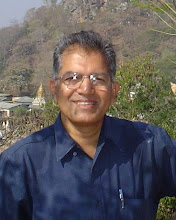
"The subtleties of De Smet's interpretation of Samkara are at times nearly as challenging as those of the great acarya himself." B.J. Malkovsky, "Introduction," The Role of Divine Grace in the Soteriology of Samkaracarya (Leiden, etc.: Brill, 2001) xvi.
"It is a tribute to the high regard that De Smet enjoyed in India that in the planning stage of the volume [New Perspectives in Advaita Vedanta] on well-known Hindu philosopher suggested to me that all the essays ought perhaps to deal with the contribution of De Smet himself to Advaita studies." Malkovsky xvi n 5.
Showing posts with label Sankara. Show all posts
Showing posts with label Sankara. Show all posts
Monday, 11 July 2011


Friday, 8 April 2011
A possible paper: the authenticity of the Mandukya Up. Bh.
More correctly: a paper using Lonergan's method to reflect on the authenticity of the Mand. Up. Bh. attributed to Sankara.
Som Raj Gupta's bhasya on the Sankara-bhasyas
The Word Speaks to the Faustian Man - a series of volumes 'by' Som Raj Gupta, published by Motilal Banarsidass. Going by the title, no one would imagine that this is a major contemporary translation of most of Sankara's works. In fact, a bhasya on the bhasyas: Gupta provides the original texts (Upanisads, Gita or Brahma-sutras as the case may be), Sankara's commentaries, and then his own commentary. I came to know about this work only because of a brief notice by De Smet of vol. 1. Reading closely, I realized that there were several volumes to follow. Luckily MLBD had copies, so now Divyadaan library has vols. 1-5, with vol. 5 in two parts. Unfortunately one has to dig beyond the title page to find out just what the particular volume is dealing with. So this might be helpful:
1: Isa, Kena, Katha and Prasna Upanisads.
2: Mundaka and Mandukya Upanisads.
3: Taittiriya and Aitereya Upanisads.
4: Chandogya Upanisad
5-1: Brhadaranyaka Upanisad, chs. 1 and 2.
5-2: Brhadaranyaka Upanisad, chs. 3-6
Projected:
6: Bhagavadgita
7 (parts 1, 2, 3): Brahmasutras.
Of the above, De Smet would reject the authenticity only of the Mandukya Up. Bh. But it is certainly useful to have the text so readily available.
Is Gupta going to do also the Upadesasahasri?
1: Isa, Kena, Katha and Prasna Upanisads.
2: Mundaka and Mandukya Upanisads.
3: Taittiriya and Aitereya Upanisads.
4: Chandogya Upanisad
5-1: Brhadaranyaka Upanisad, chs. 1 and 2.
5-2: Brhadaranyaka Upanisad, chs. 3-6
Projected:
6: Bhagavadgita
7 (parts 1, 2, 3): Brahmasutras.
Of the above, De Smet would reject the authenticity only of the Mandukya Up. Bh. But it is certainly useful to have the text so readily available.
Is Gupta going to do also the Upadesasahasri?
Monday, 4 April 2011
Anvaya-vyatireka in Sankara
- Halbfass, Wilhelm. "Human Reason and Vedic Revelation in Advaita Vedanta." Tradition and Reflection: Explorations in Indian Thought. [Albany: SUNY, 1991.] Delhi: Sri Satguru Publications, 1992 162-182. In the Preface the author notes that this article, which is ch. 5 in the book, is an enlarged and thoroughly revised version of the third of the four Studies in Kumarila and Sankara. [vii-viii.]
- Mayeda, Sengaku. “An Introduction to the Life and Thought of Śaṅkara.” Śaṅkara’s Upadeśasāhasrī. Vol. 2: Introduction and English Translation. Tr. and ed. Sengaku Mayeda. Tokyo: The Hokuseido Press, 1973. Delhi: Motilal Banarsidass, 2006. 1-97, at 46-68. Cites De Smet 66n14, 66n17, 67n28,
The Mandukya Upanisad and the Gaudapada-Karika
[Much of the matter here is from Mayeda 1967-68.]
GK: Gaudapadiyakarika.
GKBh: Sankara's Gaudapadiyabhasya.
MU: Mandukyopanisad.
MUBh: Sankara's Mandukyopanisadbhasya.
MU consists of only 12 prose sentences. [Mayeda 1967-68 73.]
In MS as well as printed editions, the MU is interspersed among the 29 stanzas of the first prakarana of the GK, which comprises 4 prakaranas explaining the MU. [Mayeda 1967-68 73.]
GK is also called Agamasastra, or Mandukyakarika. [Mayeda 1967-68 73-74.]
GKBh is also called Agamasastra-vivarana, Gaudapadiya-gamasastra-bhasya, and Gaudapadiya-gamasastra-vivarana. [Mayeda 1967-68 74n2.]
GKBh: oldest extant work before Sankara (AD 700-750), and stands in the line of Advaita philosophy. [Mayeda 1967-68 74.]
Tradition: that Sankara, commenting on both texts (MU and GK) wrote both the MUBh and GKBh. [Mayeda 1967-68 74.]
It is generally taken for granted that the GKBh and the MUBh are commented by a single hand. Mayeda finds no evidence for questioning this. [Mayeda 1967-68 75n1.]
- Bhattacharya, V. "Mandukya Upanisad and the Gaudapada Karika." Indian Historical Quarterly 1 (1925) 119-125, 295-302. [For latter pagination, see http://faculty.washington.edu/kpotter/xtxt2.htm as of 5 Apr 2011.]
- Bhattacharya, V. The Agamasastra of Gaudapada. Calcutta: University of Calcutta, 1952. 46-52. Questions authenticity of MUBh and GKBh (xxxiii n3).
- Karmarkar, R.D. Gaudapada-Karika. Poona: Government Oriental Series, Class B, No. 9, 1953) xxxi-xxxiii.
- Nakamura, H. Vedanta Tetsugaku no Hatten (= The Development of the Vedanta Philosophy) (Tokyo: Iwanami Shoten, 1955) 557-565. 527-534: Questions authenticity of MUBh and GKBh.
- Jacobi, H. "On Mayavada." Journal of the American Oriental Society 33 (1913) 51-54. [For pagination, see http://faculty.washington.edu/kpotter/xtxt2.htm as of 5 Apr 2011.] 52, n. 2: suspicion of the identity of the commentator of the GK with the author of the BSBh. [Mayeda 1967-68 74.]
- Chintamani, T.R. "Sankara - The Commentator on the Mandukya Karikas." Proceedings of the Third Oriental Conference (Madras, 1924) 419-21: objects to Jacobi. [Mayeda 1967-68 74n3.] [Till Mayeda,] Chintamani was the only scholar so far to defend the tradition [of Sankara authorship of the MUBh and GKBh], but he could not show any strong positive evidence. [Mayeda 1967-68 74n4.]
- Bhattacharya, V. "Sankara's Commentaries on the Upanisads." Sir Asutosh Mookerjee Silver Jubilee Volume, vol. 3, pt. 2 (Calcutta, 1925) 103-10: Questions the authenticity of the MUBh and the GKBh. [Mayeda 1967-68 74n4.] 104: From the fact that Sankara nowhere quotes the MU, even where it could have served his purpose, e.g. in commenting on the Chand. Up. 2, 23, 3, Bhattacharya infers that the MU itself was not written before or even in the time of Sankara. This theory is rejected by Nakamura, see Vedanta Tetsugaku... 536-539. [Mayeda 1967-68 81n2.]
- Bhattacharya, V. "The Gaudapada-Karika on the Mandukya Upanisad." Proceedings of the Second Oriental Conference (1922) 439-462. [for pagination, see http://faculty.washington.edu/kpotter/xtxt2.htm as of 5 apr 2011] 441n1, 442, 444n4, 454n1: questions authenticity of MUBh and GKBh. [Mayeda 1967-68 74n4.]
- Belvalkar, S.K. Shree Gopal Basu Mallik Lectures on Vedanta Philosophy, pt. 1 (Poona, 1929) 218: Questions authenticity of MUBh and GKBh.
- Devaraja, N.K. An Introduction to Sankara's Theory of Knowledge (Varanasi, 1962) 38-42. Questions authenticity of MUBh and GKBh.
- Venkatasubbiah, A. "The Mandukyopanisad and Gaudapada," Indian Antiquary 62 (1933) pt. DCCLXXII, 185-186: Sankara does not quote the MK at all nor even refer to it in the BSBh nd other works. [Mayeda 1967-68 81.]
- Nikhilanananda. The Mandukyopanisad with Gaudapada's Karika and Sankara's Commentary. (Mysore: Sri Ramakrishna Asrama, 1955) 217-219 and 219n1. [Mayeda 1967-68 84n3.]
- Mayeda, Sengaku. "On the Author of the Mandukyopanisad and the Gaudapadiya-Bhasya." The Adyar Library Bulletin 31-32 (1967-68) 73-94. 94: concludes that the GKBh including the MUBh is one of Sankara's genuine works.
- Vetter, T. "Die Gaudapadiya-Karikas: Zur Entstehung und zur Bedeutung von (a)dvaita." Wiener Zeitschrift fur die Kunde Sudasiens 22 (1978) 95-131. [Halbfass 1991/1992 186n41.]
- Vetter, T. Studien zur Lehre und Entwicklung Sankaras. Vienna, 1979. [Halbfass 1991/1992 139.] Like Hacker, he sees the MUBh and GKBh as the earliest document of Sankara's transition [from Yoga] to Advaita Vedanta (Halbfass 1991/1992 139).
- Vetter, T. "Erfahrung des Unerfahrbren bei Sankara." Transcendenzerfahrung, Vollzughorizont des Heils. Ed. G. Oberhammer. Vienna, 1978. 45-59. [Halbfass 1991/1992 139, 186n40.]
Thursday, 31 March 2011
Sankara as srutivadin
- Rambachan, Anantanand. "Sankara's rationale for sruti as the definite source of brahma-jnana: refutation of some contemporary views." Philosophy East and West 36 (1986) 25-40. [See Clooney, Theology After Vedanta (1993) 254.]
- Halbfass, Wilhelm. Studies in Kumarila and Sankara. In his review, De Smet is happy to note that the second study here confirms his own thesis about Sankara as srutivadin. [Understanding Sankara 434 tentative.]
- Halbfass, Wilhelm. "Human Reason and Vedic Revelation in Advaita Vedanta." Tradition and Reflection: Explorations in Indian Thought. [Albany: SUNY, 1991.] Delhi: Sri Satguru Publications, 1992 162-182. In the Preface the author notes that this article, which is ch. 5 in the book, is an enlarged and thoroughly revised version of the third of the four Studies in Kumarila and Sankara. [vii-viii.] There is no mention of De Smet in the notes or Index. In 204n208 Halbfass gives a list of studies that he found after completing the original version of this chapter (1982) dealing with reason and revelation in Sankara, but says they do not modify his thesis.
Sunday, 6 February 2011
De Smet, one of India's great advaitins
George McLean, in an email to me of 7 April 2010 (spellings corrected):
“What excited me about Fr. De Smet's original work was that it enabled the richness of Shankara and the Hindu tradition of the interior path to the divine to be re-related to the material world from which it has been separated.
Father De Smet pioneered this re-relation by opening the connection which the advaitin scholarship had severed in the interpretation of Shankara.
I see this as the key to the present need not to abandon the sacred but to show it to be the real foundation of the sense of the material life, and hence for us of the scientific world in which we now live.
I saw with my own eyes the excitement this caused at a meeting at the University of Madras when two key people jumped up at the end of his talk, which summarized the first part of his dissertation, to say that this was the way Hindu philosophy needed to be done and that he was one of the greatest advaitins in India, indeed in the whole world.”
Sunday, 16 January 2011
De Smet on Sankara's acosmism
My impression is that, while De Smet in 1953 defended the thesis that Sankara was a srutivadin, and while he discovered in him a theory of analogy (laksana) that corresponded closely to the intrinsic analogy of Aquinas, he had not as yet come clearly to the affirmation that Sankara was not an acosmist. This needs to be confirmed by a reading of the text of his dissertation.
By 1964/68 (his article for Religious Hinduism) - and perhaps already in 1958 (the first edition of this article) - he is certainly maintaining that Sankara is not an acosmist. The notes (Guidelines in Indian Philosophy), which bear a 1968 date on the front page, also bear this out quite abundantly.
It might be another interesting study to find out the position of the Calcutta School of Catholic Indologists on the matter. What did Johanns and Dandoy think? Pessein? Etc.
By 1964/68 (his article for Religious Hinduism) - and perhaps already in 1958 (the first edition of this article) - he is certainly maintaining that Sankara is not an acosmist. The notes (Guidelines in Indian Philosophy), which bear a 1968 date on the front page, also bear this out quite abundantly.
It might be another interesting study to find out the position of the Calcutta School of Catholic Indologists on the matter. What did Johanns and Dandoy think? Pessein? Etc.
Saturday, 5 June 2010
Quiet gratitude...
I wrote this morning that I have been struggling with my paper for the forthcoming Workshop in Boston. I write now, in the late evening, with some measure of satisfaction and gratitude. Gratitude is the only proper word, for the insights that are not under the command of our will, for their arrival, their giftedness....
Not that there have been major insights. But it has been a day of quiet, mostly flowing, writing. I experienced the goodness of having small summaries of the main points hanging out in print. I suppose that was the point of the old schede system. And once again, the importance of not being kanjoos, of generously printing out (despite the damage to the trees!), because insight calls for the phantasm!
Also the importance of having more or less worked out what seems to be a workable scheme. Then, with the schede / printouts in front of you, you can read slowly, ruminate, pommel things into shape, insert.
So today I found myself wanting to modify the three part scheme I had worked out for De Smet on Sankara. The first part of quite okay, not really problematic, the part about Sankara's stage of meaning and mode of expression, though I found it clicking rather well with what I had written / suggested last year: Sankara is really in the 'mixed mode' that is neither purely symbolic nor yet fully systematic.
The second part really needed modification or expansion, and that because of the introductory part of my paper, or better the overall aim of my paper: Retrieving Good Work. Such retrieval involved attempting to read De Smet / Sankara from generalized method. How do I do that? I am just falling back, without too much fuss, on the little notes I had made already. So I incorporated, without being too ambitious, notes on Sankara on experience/ consciousness, understanding, judging; on being; on objectivity. Now that I write that, perhaps I must try to see whether I can do something similar also about meaning, given the importance that vakya / sentence / proposition plays in Sankara's exegesis. ...
So that's where I am, and its a good feeling.
Not that there have been major insights. But it has been a day of quiet, mostly flowing, writing. I experienced the goodness of having small summaries of the main points hanging out in print. I suppose that was the point of the old schede system. And once again, the importance of not being kanjoos, of generously printing out (despite the damage to the trees!), because insight calls for the phantasm!
Also the importance of having more or less worked out what seems to be a workable scheme. Then, with the schede / printouts in front of you, you can read slowly, ruminate, pommel things into shape, insert.
So today I found myself wanting to modify the three part scheme I had worked out for De Smet on Sankara. The first part of quite okay, not really problematic, the part about Sankara's stage of meaning and mode of expression, though I found it clicking rather well with what I had written / suggested last year: Sankara is really in the 'mixed mode' that is neither purely symbolic nor yet fully systematic.
The second part really needed modification or expansion, and that because of the introductory part of my paper, or better the overall aim of my paper: Retrieving Good Work. Such retrieval involved attempting to read De Smet / Sankara from generalized method. How do I do that? I am just falling back, without too much fuss, on the little notes I had made already. So I incorporated, without being too ambitious, notes on Sankara on experience/ consciousness, understanding, judging; on being; on objectivity. Now that I write that, perhaps I must try to see whether I can do something similar also about meaning, given the importance that vakya / sentence / proposition plays in Sankara's exegesis. ...
So that's where I am, and its a good feeling.
Friday, 4 June 2010
Boston 2010
Still struggling with the paper for Boston 2010. Backbreaking! You work through the year, and then through the summer, and then the year begins again... But then, what would I do if there were nothing to do?
At any rate: the first part of the paper, which is a Lonerganish background attempting to unfold what "Retrieving Good Work" might mean, seems to be relatively stable. I began, strangely, only now to understand the difference between the hermeneutical canon of relevance and the the canon of explanation. These two seem to parallel the later distinction between the functional specialities interpretation and history, except that 'determining the particular viewpoint' is shifted out to dialectic.
The second part is the tricky one: there are no paths here. As McShane wrote to me, you have to create the path here, and that is done by walking!
All these days I was working at a sort of 'raising of categories' in Sankara as seen by De Smet: judgment (pratyaksa, which is sense perception), understanding (clearly Sankara is intellectualist), experience (the Buddhists and the Purva Mimamsakas speak of bare sensation or the nirvikalpa phase of pratyaksa, but I have not found Sankara doing so; but Sankara does, of course, speak of consciousness, and he has a notion of consciousness as experience, I propose); intellectual dynamism, being (I found that very difficult, because Sankara has so many things to say on this point, and it is one of the controverted points!), objectivity (yathatmya; the self-validity of judgment or sva-prakasatva, which De Smet says is the only sensible approach to knowing). I was trying to work out also the 'metaphysical' categories (cause, relation, tadatmya, atman) but did not get far.
Yesterday another approach: De Smet himself provides three points: (1) establishing that Sankara is a srutivadin, a theologian, an exegete of scripture, rather than a systematic philosopher; (2) showing that Sankara's extra-textual understanding of understanding and of meaning (intellection and vakya, in his terms) determines his exegesis; (3) the interpretation itself: Sankara as non-dualist rather than acosmist or monist.
These points correspond neatly to (1) establishing the level of expression and stage of meaning; (2) showing how cognitional theory and its extensions - generalized method or the general and special categories - influence exegesis; (3) the exegesis itself.
Will it work? Let's hope so.
At any rate: the first part of the paper, which is a Lonerganish background attempting to unfold what "Retrieving Good Work" might mean, seems to be relatively stable. I began, strangely, only now to understand the difference between the hermeneutical canon of relevance and the the canon of explanation. These two seem to parallel the later distinction between the functional specialities interpretation and history, except that 'determining the particular viewpoint' is shifted out to dialectic.
The second part is the tricky one: there are no paths here. As McShane wrote to me, you have to create the path here, and that is done by walking!
All these days I was working at a sort of 'raising of categories' in Sankara as seen by De Smet: judgment (pratyaksa, which is sense perception), understanding (clearly Sankara is intellectualist), experience (the Buddhists and the Purva Mimamsakas speak of bare sensation or the nirvikalpa phase of pratyaksa, but I have not found Sankara doing so; but Sankara does, of course, speak of consciousness, and he has a notion of consciousness as experience, I propose); intellectual dynamism, being (I found that very difficult, because Sankara has so many things to say on this point, and it is one of the controverted points!), objectivity (yathatmya; the self-validity of judgment or sva-prakasatva, which De Smet says is the only sensible approach to knowing). I was trying to work out also the 'metaphysical' categories (cause, relation, tadatmya, atman) but did not get far.
Yesterday another approach: De Smet himself provides three points: (1) establishing that Sankara is a srutivadin, a theologian, an exegete of scripture, rather than a systematic philosopher; (2) showing that Sankara's extra-textual understanding of understanding and of meaning (intellection and vakya, in his terms) determines his exegesis; (3) the interpretation itself: Sankara as non-dualist rather than acosmist or monist.
These points correspond neatly to (1) establishing the level of expression and stage of meaning; (2) showing how cognitional theory and its extensions - generalized method or the general and special categories - influence exegesis; (3) the exegesis itself.
Will it work? Let's hope so.
Tuesday, 1 June 2010
The metaphysical depth of things
I am, I think, finally beginning to understand what Joaquim might have meant when he used to speak of the 'metaphysical depth' of things. But - I am not really sure what Joaquim meant.
Reading De Smet on Sankara, it is becoming clear that, in Sankara's perspective, all ordinary knowledge is a-Vidya, precisely because it does not go to the true depth of reality - which is the Brahman-Atman. Here is one summary of what he says:
Reading De Smet on Sankara, it is becoming clear that, in Sankara's perspective, all ordinary knowledge is a-Vidya, precisely because it does not go to the true depth of reality - which is the Brahman-Atman. Here is one summary of what he says:
Knowledge results from the sources of valid knowledge whose objects are existent things as they are in reality. (B.S.Bh. 1, 1, 4) The objective identity, yathatmya, is not easy to attain. Things have a physical substantiality, which pratyakṣa and anumāna can ascertain, but also a metaphysical depth, namely, their total dependence on their Cause. So long as we ignore or deny this, our knowledge has not yet reached yathatmya. However correct it may be as far as it goes, it is avidya, for it lacks the complement and finality which śruti alone can give. The śruti will not cancel its content but only its pretention of having reached exhaustively the yathatmya of things. [“Śaṅkara’s Non-Dualism” Religious Hinduism 1997 86.]
Monday, 31 May 2010
Sankara and Thomas
Is Sankara perhaps as systematic or unsystematic as Thomas? Both wrote a large number of commentaries. Sankara seems to have written only one 'systematic' work that is today acknowledged as authentic, the Upadesasahasri, while Thomas wrote De ente et essentia. But then Thomas wrote two Summas, and that is his great claim to system. Remember Lonergan and his remarks on the method of the quaestio: one needs something that will bring together the great diversity of principles adopted in answering questions; one needs a common Begrifflichkeit; and Thomas found this by adopting and adapting Aristotle. Aristotle adopted and adapted provided him with the required unifying factor. Sankara perhaps did not get round to this; did not want to get round to this; his aim being purely valuational.
Monday, 17 May 2010
Haunted by language
In a culture that is reputed for its apophatism, it is initially surprising to find De Smet writing:
Despite this, it is good to keep in mind also this: that Sankara is "the foremost master among Indian schoolmen as well as a staunch upholder of negative theology." (Ibid. 50)
More than most human beings, Sankara is haunted by language. ("Sankara's Perspective on Meaning and Truth," Hermeneutics, Truth and/or Meaning, ed. J. Maliekal. Kondadaba: St John's Regional Seminary, 1994. 51)And of course, De Smet is among those who have done most to uncover this haunting, by concentrating on Sankara's exegesis of the five varieties of mahavakyas, with the help of the (then well-known) distinctions between the primary and the secondary meanings of words.
Despite this, it is good to keep in mind also this: that Sankara is "the foremost master among Indian schoolmen as well as a staunch upholder of negative theology." (Ibid. 50)
Thursday, 18 March 2010
Retrieval of good work
What exactly did I do in my Boston paper of 2009, "Person and Subject in Lonergan: A Methodical Transposition"?
Ostensibly, it deal with Lonergan's transposition of the metaphysical term person into the psychological term subject. This itself took place in the context of his effort to transform the language of Christian doctrines from a metaphysical to a methodical context. Thus the one person two natures of Christ became one subject and two subjectivities of Christ.
But what Lonergan actually does is to generate a set of interlocking terms and relations from appropriation of interiority (see Insight, and then Method in a different way). This is then used as an upper blade to recast doctrines and eventually systematics.
My question is: what to do with a work like that of De Smet on Sankara?
I am just thinking aloud.
1. My first reaction would be to say: let's do research, interpretation, history, dialectic, foundations on Sankara; this will generate a basic set of general categories (and perhaps also special categories). This would be justified in some way by Lonergan's call in Method ch. 11: Foundations to appropriate interiority through the writings of saints and holy people in different traditions.
1.1 Research as applied to Sankara is quite clear: bibliographies, critical editions, translations, lexicons, etc. Interpretation would (a) complete what was lacking (the bibliographies would identify work done and work remaining to be done); (b) retrieve in a methodical key good work already done (is this a requirement of Insight or of Method?)
1.2 Since I am interested in De Smet on Sankara, what could I do? Where would this fit in? Obviously in 1.1.b: retrieval of good work in a methodical key. But what does such retrieval involve? I do not seem to be clear on this point.
1.3 Here is some help from Method. Lonergan notes that a serious contribution to one of the eight specialties is all that can be demanded of a single piece of work; in fact, the distinction and division of specialties enables us to resist excessive demands (Method 137).
Again, he envisages an interim period until method is generally recognized. In this interim period, any single contribution will have a major part and a minor part.
The major part is to produce evidence proper to the specialty. The examples Lonergan gives are: the exegete, the historian, the doctrinal theologian, and the systematic theologian. We may note that dialectic and foundations are not mentioned, though research and communications are equally absent.
The minor part serves to preclude misunderstanding, misinterpretation and misrepresentation. It consists in drawing attention to the fact of specialization and gives some indication of the specialist's awareness of what is to be added to his statements in the light of the evidence available to other specialties. (Method 137-138)
The point is that Lonergan envisages quite independent efforts in the functional specialties - even in doctrines and systematics, which should presuppose the categories generated in dialectic and foundations!
Of course it is easier to envisage efforts in research and in interpretation. For even if research is incomplete, interpretation can be launched. What about history? If interpretations are incomplete, can functional history be done? I am not so sure about that.
And what about doctrines? How to do functional doctrines in the absence of categories generated in foundations? Is some shortcut presupposed here? And what of systematics?
1.4 Still, all this is merely support for independent pursuit of functional specialties in the interim period - which, after all, is not so difficult. A study of De Smet on Sankara will not fit exactly into this kind of thing - though it could well be a species of functional interpretation.
What is relevant to me is rather the remark on "retrieval of good work already done" which is to be found in Insight ch. 17. Two points: (a) This remark is in Insight; how valid is it in the context of Method? (b) How to go about such retrieval, even if it is still valid?
Here is the retrieval remark, Insight 610: the possibility of an explanatory interpretation of a non-explanatory meaning. The original writer's meaning may have its source in insights into things as related to him, and in all probability he will have no clear notion of insight nor any distinct advertence to the occurrence of insights. Still, he had the insights, and these were either different or not different from the insights of other earlier, contemporary, and later writers. If they were different, they stood in some genetic and dialectical relations with those other sets.
It is through these genetic and dialectical relations that interpretation is explanatory. It is through these relations that explanatory interpretation conceives, defines, reaches the insights of a given writer. It reaches the descriptive knowledge of a writer by establishing the verifiable differences between writers.
Insight goes on to speak of the canon of successive approximations, which deals with the necessary division of labour. This need is met by establishing reliable principles of criticism which will select what is satisfactory and reject what is unsatisfactory in any single contribution.
These principles are four: (1) the demand for a universal viewpoint; (2) taking advantage of the conditions of the extrapolation of meaning; (3) taking advantage of the genetic sequence of modes of expression, and the recurrent gap between meaning and expression; (4) taking advantage of the goal, which is truth, the criterion of which is the virtually unconditioned. (Insight 610-612)
The first principle of criticism seems to repeat the first canon, which is the canon of relevance, and which demands that the interpreter begin from the universal viewpoint, and that his interpretation convey some differentiation of the protean notion of being. It applies this canon to contributions that fail to present results in terms of the universal viewpoint: a critic can proceed from the universal viewpoint to determine the contributor's particular viewpoint, identify valid elements, and point out to "others working in the contributor's special field" the points needing revision. (Insight 611)
Ostensibly, it deal with Lonergan's transposition of the metaphysical term person into the psychological term subject. This itself took place in the context of his effort to transform the language of Christian doctrines from a metaphysical to a methodical context. Thus the one person two natures of Christ became one subject and two subjectivities of Christ.
But what Lonergan actually does is to generate a set of interlocking terms and relations from appropriation of interiority (see Insight, and then Method in a different way). This is then used as an upper blade to recast doctrines and eventually systematics.
My question is: what to do with a work like that of De Smet on Sankara?
I am just thinking aloud.
1. My first reaction would be to say: let's do research, interpretation, history, dialectic, foundations on Sankara; this will generate a basic set of general categories (and perhaps also special categories). This would be justified in some way by Lonergan's call in Method ch. 11: Foundations to appropriate interiority through the writings of saints and holy people in different traditions.
1.1 Research as applied to Sankara is quite clear: bibliographies, critical editions, translations, lexicons, etc. Interpretation would (a) complete what was lacking (the bibliographies would identify work done and work remaining to be done); (b) retrieve in a methodical key good work already done (is this a requirement of Insight or of Method?)
1.2 Since I am interested in De Smet on Sankara, what could I do? Where would this fit in? Obviously in 1.1.b: retrieval of good work in a methodical key. But what does such retrieval involve? I do not seem to be clear on this point.
1.3 Here is some help from Method. Lonergan notes that a serious contribution to one of the eight specialties is all that can be demanded of a single piece of work; in fact, the distinction and division of specialties enables us to resist excessive demands (Method 137).
Again, he envisages an interim period until method is generally recognized. In this interim period, any single contribution will have a major part and a minor part.
The major part is to produce evidence proper to the specialty. The examples Lonergan gives are: the exegete, the historian, the doctrinal theologian, and the systematic theologian. We may note that dialectic and foundations are not mentioned, though research and communications are equally absent.
The minor part serves to preclude misunderstanding, misinterpretation and misrepresentation. It consists in drawing attention to the fact of specialization and gives some indication of the specialist's awareness of what is to be added to his statements in the light of the evidence available to other specialties. (Method 137-138)
The point is that Lonergan envisages quite independent efforts in the functional specialties - even in doctrines and systematics, which should presuppose the categories generated in dialectic and foundations!
Of course it is easier to envisage efforts in research and in interpretation. For even if research is incomplete, interpretation can be launched. What about history? If interpretations are incomplete, can functional history be done? I am not so sure about that.
And what about doctrines? How to do functional doctrines in the absence of categories generated in foundations? Is some shortcut presupposed here? And what of systematics?
1.4 Still, all this is merely support for independent pursuit of functional specialties in the interim period - which, after all, is not so difficult. A study of De Smet on Sankara will not fit exactly into this kind of thing - though it could well be a species of functional interpretation.
What is relevant to me is rather the remark on "retrieval of good work already done" which is to be found in Insight ch. 17. Two points: (a) This remark is in Insight; how valid is it in the context of Method? (b) How to go about such retrieval, even if it is still valid?
Here is the retrieval remark, Insight 610: the possibility of an explanatory interpretation of a non-explanatory meaning. The original writer's meaning may have its source in insights into things as related to him, and in all probability he will have no clear notion of insight nor any distinct advertence to the occurrence of insights. Still, he had the insights, and these were either different or not different from the insights of other earlier, contemporary, and later writers. If they were different, they stood in some genetic and dialectical relations with those other sets.
It is through these genetic and dialectical relations that interpretation is explanatory. It is through these relations that explanatory interpretation conceives, defines, reaches the insights of a given writer. It reaches the descriptive knowledge of a writer by establishing the verifiable differences between writers.
Insight goes on to speak of the canon of successive approximations, which deals with the necessary division of labour. This need is met by establishing reliable principles of criticism which will select what is satisfactory and reject what is unsatisfactory in any single contribution.
These principles are four: (1) the demand for a universal viewpoint; (2) taking advantage of the conditions of the extrapolation of meaning; (3) taking advantage of the genetic sequence of modes of expression, and the recurrent gap between meaning and expression; (4) taking advantage of the goal, which is truth, the criterion of which is the virtually unconditioned. (Insight 610-612)
The first principle of criticism seems to repeat the first canon, which is the canon of relevance, and which demands that the interpreter begin from the universal viewpoint, and that his interpretation convey some differentiation of the protean notion of being. It applies this canon to contributions that fail to present results in terms of the universal viewpoint: a critic can proceed from the universal viewpoint to determine the contributor's particular viewpoint, identify valid elements, and point out to "others working in the contributor's special field" the points needing revision. (Insight 611)
Monday, 8 March 2010
The active synthesizing nature of intellect in Sankara
What enables us to synthesize disparate sounds and to comprehend their meaning? Here is the solution of Prabhakara (and also Bhatta):
Words are combinations of letters or rather syllables (varna). But how can we understand words and sentences when each syllable vanishes the moment it is uttered? The solution can be found either in our intellect or in sabda itself. For Prabhakara, it is found in the latter. Varnas have each an (eternal) potency of leaving a semantic impression which, combined with that of other varnas brings about the meaning of words and sentences.... (De Smet, Guidelines p. 219)Sankara was dissatisfied with this solution
because it is too particular to the understanding of a series of syllables. We should have a general solution which would explain our understanding of other kinds of series too (line of ants, of trees, of soldiers, etc.) Besides, in any case the impressions left by the varnas must be synthesized by the intellect. Hence, the solution must be found in the intellect. In fact, it is simpler to admit that our buddhi functions as intellectual memory, i.e., has the power of synthesizing elements apprehended at successive moments of time. This function is samasta-praty-avamarsini buddhi (intellect looking back on past experiences as a whole). Cf. Brahma-sutra-bhasya, 1,3,28. (De Smet, Guidelines p. 219)Yet more evidence for the active nature of intellect in Sankara.
Sunday, 7 March 2010
Bhasya and Quaestio
In his Guidelines in Indian Philosophy, p. 208, De Smet makes the interesting observation that the bhasya method developed by the 'schoolmen' of India is almost identical with the method of the quaestio developed independently by the medieval Schoolmen of Europe.
In the bhasya method, each topic is to be explained and settled in 5 steps: (1) the object (visaya) of the sutras concerning that topic is declared; (2) the doubt (samsaya) regarding that object; (3) the prima facie view (purvapaksa) which has some plausibility but which contradicts the tradition of the bhasyakara; (4) the final and authoritative opinion (uttarapaksa or siddhanta) is explained and defended and established; (5) this accepted opinion is then applied to other passages (samgati) which both confirm and are explained by it.
I find it exciting that questioning and dialectic is once again, in India as in the West, the road to truth.
In the bhasya method, each topic is to be explained and settled in 5 steps: (1) the object (visaya) of the sutras concerning that topic is declared; (2) the doubt (samsaya) regarding that object; (3) the prima facie view (purvapaksa) which has some plausibility but which contradicts the tradition of the bhasyakara; (4) the final and authoritative opinion (uttarapaksa or siddhanta) is explained and defended and established; (5) this accepted opinion is then applied to other passages (samgati) which both confirm and are explained by it.
I find it exciting that questioning and dialectic is once again, in India as in the West, the road to truth.
Wednesday, 20 January 2010
Sayana and Anandagiri
In "Langage et Connaissance de l'Absolu chez Samkara" De Smet casually mentions Sayana's and Anandagiri's sub-commentaries on the Taitt. Up., without giving any further references. I have been able to find the following details:
Tika of Anandagiri on Shankaracharya's Bhashya on the Taittiriya Upanishad
Upanishad-bhashya-sangraha, Mahesanusandhana Samsthanam, Mt. Abu, 1979-1986. Sankara's bhAshyas on the kaTha, mANDUkya, taittirIya, chAndogya and bRhadAraNyaka upanishad, with Anandagiri's TIkAs and other sub-commentaries. See http://www.advaita-vedanta.org/avhp/biblio.html
Sayanacharya's Bhasya (part of commentary on the entire Taittiriya Aranyaka)
Taittiriya Aranyaka, with Sayana Bhashya . Anandashram, Pune 1926. See http://en.wikipedia.org/wiki/Aranyaka
A. Mahadeva Sastri. Taittiriya Upanishad: with the commentaries of Sankaracharya, Suresvaracharya, and Sayana (Vidyaranya), pp. 80 (free download at: http://www.archive.org/download/taittiriyaupanis00sankiala/taittiriyaupanis00sankiala.pdf)
Tika of Anandagiri on Shankaracharya's Bhashya on the Taittiriya Upanishad
Upanishad-bhashya-sangraha, Mahesanusandhana Samsthanam, Mt. Abu, 1979-1986. Sankara's bhAshyas on the kaTha, mANDUkya, taittirIya, chAndogya and bRhadAraNyaka upanishad, with Anandagiri's TIkAs and other sub-commentaries. See http://www.advaita-vedanta.org/avhp/biblio.html
Sayanacharya's Bhasya (part of commentary on the entire Taittiriya Aranyaka)
Taittiriya Aranyaka, with Sayana Bhashya . Anandashram, Pune 1926. See http://en.wikipedia.org/wiki/Aranyaka
A. Mahadeva Sastri. Taittiriya Upanishad: with the commentaries of Sankaracharya, Suresvaracharya, and Sayana (Vidyaranya), pp. 80 (free download at: http://www.archive.org/download/taittiriyaupanis00sankiala/taittiriyaupanis00sankiala.pdf)
Tuesday, 23 June 2009
Making things better than they were
Fred Lawrence mentioned something yesterday in his comment on my paper, about making Sankara better than he is. And yes, I thought, that is how De Smet has proceeded, not only w.r.t. Sankara, but w.r.t. to the whole Indian tradition that he studied: his eye of love enabled him to see things as perhaps better than they were. And, if that sounds terribly triumphalistic, perhaps it was that his eye of love saw and highlighted and promoted the good.
So interpretation and history might concentrate on What did he mean, and What really was going forward, but dialectic tries to develop the positions while reversing the counterpositions. Developing the positions: making things better than they were. Taking the good things forward in directions that perhaps were not actually taken by the protagonists.
So De Smet's interpretation of Sankara, even if proved 'wrong,' would certainly be in the line of such dialectic. And that is a legitimate thing!
So interpretation and history might concentrate on What did he mean, and What really was going forward, but dialectic tries to develop the positions while reversing the counterpositions. Developing the positions: making things better than they were. Taking the good things forward in directions that perhaps were not actually taken by the protagonists.
So De Smet's interpretation of Sankara, even if proved 'wrong,' would certainly be in the line of such dialectic. And that is a legitimate thing!
Tuesday, 9 June 2009
Person and Subject in Lonergan
Yesterday I managed to complete a more or less final version of my paper for Boston. Now the task of going through it once again, doing the 'toilet,' etc.
The title: "Person and Subject in Lonergan: A methodical transposition." I have omitted mention of De Smet and Sankara, because I am not really doing that, merely indicating possible results of using 'subject' as upper blade.
So most of the paper consists in bringing together the data in Lonergan on his transposition from person to subject. The data is found mostly in his Latin notes: De Constitutione Christi... (1956), Divinarum Personarum... (1957) = De Deo Trino, II (1964), and De Verbo Incarnato (1961). There is some good matter also in "Christ as Subject" (1959).
Nothing dramatic or earth-shaking. But it is instructive how Lonergan is able to make the term person systematic by inserting it within a clutch of terms, and similarly for the term subject. The former is inserted into a (largely classical) metaphysical context, while the latter is inserted into that of intentionality analysis. The crucial and critical notion as far as the latter is concerned is consciousness.
I became aware that the dialectic of consciousness is based on the Aristotelian-Thomist theorem of knowing by identity (sensible in act is the sense in act, intelligible in act is the intellect in act), but that this is precisely a theorem, a postulate, an assumption. That is why, perhaps, the 'epistemology' of Insight, the dialectical part (chapter 14), does not make use of it, appealing instead to the basic counterpositions or performative contradictions.
Using this data to read De Smet on Sankara, I discussed briefly the following: cognitional theory, the notion of being, consciousness, the human self.
The conclusion is that there is sufficient data in Sankara to indicate that he recognized both divine and human subjects, and that his notion of consciousness seems to be consciousness-experience. But all these are heuristic anticipations, to be confirmed by further and full study of the data.
The title: "Person and Subject in Lonergan: A methodical transposition." I have omitted mention of De Smet and Sankara, because I am not really doing that, merely indicating possible results of using 'subject' as upper blade.
So most of the paper consists in bringing together the data in Lonergan on his transposition from person to subject. The data is found mostly in his Latin notes: De Constitutione Christi... (1956), Divinarum Personarum... (1957) = De Deo Trino, II (1964), and De Verbo Incarnato (1961). There is some good matter also in "Christ as Subject" (1959).
Nothing dramatic or earth-shaking. But it is instructive how Lonergan is able to make the term person systematic by inserting it within a clutch of terms, and similarly for the term subject. The former is inserted into a (largely classical) metaphysical context, while the latter is inserted into that of intentionality analysis. The crucial and critical notion as far as the latter is concerned is consciousness.
I became aware that the dialectic of consciousness is based on the Aristotelian-Thomist theorem of knowing by identity (sensible in act is the sense in act, intelligible in act is the intellect in act), but that this is precisely a theorem, a postulate, an assumption. That is why, perhaps, the 'epistemology' of Insight, the dialectical part (chapter 14), does not make use of it, appealing instead to the basic counterpositions or performative contradictions.
Using this data to read De Smet on Sankara, I discussed briefly the following: cognitional theory, the notion of being, consciousness, the human self.
The conclusion is that there is sufficient data in Sankara to indicate that he recognized both divine and human subjects, and that his notion of consciousness seems to be consciousness-experience. But all these are heuristic anticipations, to be confirmed by further and full study of the data.
Subscribe to:
Posts (Atom)