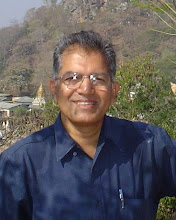
I had a rather fruitful holiday in Goa... this time indulging my taste for history.
I visited the State Central Library at Panjim and had a look at the MS of the Khristapurana preserved there. It is the closest thing we have to the third (1654) edition of the KP. Mr Carlos Fernandes, the Curator, was really helpful. Among other things, he placed orders for 10 copies each of Falcao's ed. of the Khristapurana, Brahman and Person: Essays by Richard De Smet, and Divyadaan: Journal of Philosophy and Education. I was also fortunate to meet Pia de Menezes Rodrigues, former Curator.
The second important visit was to Prof. S.M. Tadkodkar, HoD Marathi of the Goa University, who has come out with an important book, Goan Christian Marathi Vilapika during the 16th Century, in which he proposes that 2 of the 3 Paixao de Christo at the end of the Central Library MS of the KP were written by Thomas Stephens himself. The Prof. was very cordial when I went to meet him, and introduced me to a friend of his, Ivo dos Remedios Furtado of Alto Porvorim, another history buff. Neither of them were aware of any other MS of the KP in Goa, though Prof. Tadkodkar did say in passing that St Aloysius College has some 35 MS, the ones used by Saldanha...
By chance I heard Fr Michael Mascarenhas saying that Pilar had an MS of the KP. I made the time to go over, met Fr Cosme Costa, who was another extremely helpful person despite his infirmities, and saw the MS. It needs conservation, but is, in my opinion, older than the Central Library MS - it does not have the interpolations.
While at Pilar I also picked up some books of Fr Costa, among them the one proposing that there were Christians in Goa before the Portuguese came, Christians who traced their faith back to the Apostles Thomas and Bartholomew!
Showing posts with label Thomas Stephens. Show all posts
Showing posts with label Thomas Stephens. Show all posts
Wednesday, 12 May 2010


Saturday, 4 July 2009
Heidegger and Lonergan
Heidegger and Lonergan: that is a work that remains to be done. But there are tantalizing openings: the theorem of knowing as identity, and the 'overcoming' of the subject-object split; understanding as pati, and the decentering of the subject; and so on. I guess some of these themes were mentioned in my article on Fred Lawrence. It is certainly Fred who has opened up these pathways for me.
Nelson Falcao was just telling me that the second chapter of his dissertation on Thomas Stephens' Khrista Purana was largely dependent on Heidegger's understanding of understanding. Francis de Sa is, of course, a Heidegger and Gadamer and Pannikar enthusiast. Johnson Puthenpurackal used to say that Panikkar is not original, which I gather is a way of saying that he has drawn much of his original insights from Heidegger and Gadamer: remember logos and mythos, the Spirit bearing witness as the 'third' speaking in us and inspite of us, and so on. But a rather fascinating 'inculturation', I must say. I find both Heidegger and Pannikkar fascinating in a way that Gadamer and Lonergan are simply not. Lonergan gives precious little foothold to the imagination, which is his bane. He cuts the umbilical cord tying man to the maternal imagination with a vengeance that most of his readers have still to forgive.
And of course I cannot help remembering De Smet's story of how Panikkar had sent him the manuscript of the first edition of The Unknown Christ. De Smet had taken time out and sent back 30 pages of Indological corrections, none of which were incorporated into the published text.... I think I have a copy of those corrections. It would be a fascinating study. That says nothing about the originality and the apport of an author such as Pannikkar, of course. One does not have to be an interpres fidelis in order to make a contribution or a mark. One puts things into one's pot, and one speaks in oratione recta; without footnotes, as it were.
Or else, one allows Being to speak through. So I said to Nelson this evening: perhaps the Khrista Purana emerged like that through the instrumentality of Thomas Stephens. Perhaps it just flowed out, from his deep familiarity with his own tradition, with the Hindu puranic tradition, and certainly from a deep communion with God....
Nelson Falcao was just telling me that the second chapter of his dissertation on Thomas Stephens' Khrista Purana was largely dependent on Heidegger's understanding of understanding. Francis de Sa is, of course, a Heidegger and Gadamer and Pannikar enthusiast. Johnson Puthenpurackal used to say that Panikkar is not original, which I gather is a way of saying that he has drawn much of his original insights from Heidegger and Gadamer: remember logos and mythos, the Spirit bearing witness as the 'third' speaking in us and inspite of us, and so on. But a rather fascinating 'inculturation', I must say. I find both Heidegger and Pannikkar fascinating in a way that Gadamer and Lonergan are simply not. Lonergan gives precious little foothold to the imagination, which is his bane. He cuts the umbilical cord tying man to the maternal imagination with a vengeance that most of his readers have still to forgive.
And of course I cannot help remembering De Smet's story of how Panikkar had sent him the manuscript of the first edition of The Unknown Christ. De Smet had taken time out and sent back 30 pages of Indological corrections, none of which were incorporated into the published text.... I think I have a copy of those corrections. It would be a fascinating study. That says nothing about the originality and the apport of an author such as Pannikkar, of course. One does not have to be an interpres fidelis in order to make a contribution or a mark. One puts things into one's pot, and one speaks in oratione recta; without footnotes, as it were.
Or else, one allows Being to speak through. So I said to Nelson this evening: perhaps the Khrista Purana emerged like that through the instrumentality of Thomas Stephens. Perhaps it just flowed out, from his deep familiarity with his own tradition, with the Hindu puranic tradition, and certainly from a deep communion with God....
Subscribe to:
Posts (Atom)