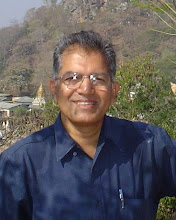
In the context of Richard Howards and Joanna Swanger's forthcoming book, Gandhi and the Future of Economics: Imaginary Dialogues between Gandhi and Some Indian Intellectuals, I was thinking of a future dialogue between Gandhi and Lonergan. If Lonergan could contribute a spine of hardcore economic theory to Gandhian intuitions, we might have a viable alternative to support obvious good will (I am thinking here of Singh). I was thinking this morning: here is a government whose survival depends on controlling the prices; yet it seems unable to do it. So perhaps it does not know how to. What if someone were to say how? What is an economic science focused on prices were barking up the wrong tree? What if we need to recognize productivity as the generator engine of economic growth, distinguish two types of product, and systematically work out its implications?
Showing posts with label Gandhi. Show all posts
Showing posts with label Gandhi. Show all posts
Tuesday, 24 July 2012


Thursday, 31 December 2009
Hierarchical and equalitarian societies
From De Smet I learned the difference between the organicity of the Christian concept of person, and the atomism of rationalist individualism. The former seems to be the mark of all organically related, hierarchical societies. The latter seems to be, instead, the presupposition or the foundation of modern (and technological) democracies.
This insight is not exclusive to De Smet. He himself draws on Alexis de Tocqueville, Democracy in America, for example. (See De Smet, Brahman and Person, 2010 69.)
Strange that I had to come across the very same reference - and insight - in Edward Rutherfurd's historical novel, Sarum.
And then again in Richard Howard's ongoing series of articles in Divyadaan on Gandhi. The difference between Gandhi and Nehru - one of the differences - is that between an organic, hierarchical, pre-modern society and an atomistic, modern society.
But there is food for thought here. For the hierarchical societies are prone to structural injustices, such as the caste system, while the equalitarian societies attempt at least to do away with such. Logically, in fact, Gandhi defended the varna system, while Ambedkar attacked this system and the hierarchical society to which it belonged, opting for modern democracy.
This insight is not exclusive to De Smet. He himself draws on Alexis de Tocqueville, Democracy in America, for example. (See De Smet, Brahman and Person, 2010 69.)
Strange that I had to come across the very same reference - and insight - in Edward Rutherfurd's historical novel, Sarum.
And then again in Richard Howard's ongoing series of articles in Divyadaan on Gandhi. The difference between Gandhi and Nehru - one of the differences - is that between an organic, hierarchical, pre-modern society and an atomistic, modern society.
But there is food for thought here. For the hierarchical societies are prone to structural injustices, such as the caste system, while the equalitarian societies attempt at least to do away with such. Logically, in fact, Gandhi defended the varna system, while Ambedkar attacked this system and the hierarchical society to which it belonged, opting for modern democracy.
Saturday, 26 December 2009
Nehru and Gandhi on economics
I have begun editing the first issue of the Divyadaan Journal for 2010, and yesterday I was working on Howard and Swanger's chapter 2, which is on Jawarharlal Nehru's peculiar relationship to Gandhi. I find myself amazed at the way Howard and Swanger are interpreting Gandhi: here is an interpretation that rings true, and that I for one have never seen.
Howard points out that Nehru never really understood Gandhi. Nehru was a Fabian socialist; he was a 'modern'; Gandhi was pre-modern. Gandhi believed in dharma, in an organic society, and his ideas make sense only within this kind of a world view. Gandhi considered modern technological society as adharma; and he was, says Howard, profoundly right. His views and his analyses are being slowly confirmed by many thinkers today.
There is, of course, the ticklish issue of Gandhi's upholding of the varnadharma, the caste system in its varna essentials at least. Howard deals with this in his chapter 1 (published in DJPE 20/3 of 2009), and he has an interesting take on it, making Gandhi intelligible if not completely defensible.
But the ideological divide between Nehru and Gandhi is interesting, it is sharp, and it had enormous consequences. We are reaping the consequences of Nehruvian socialism. True, everyone is looking at India these days, and marvelling at our progress; even Pope Benedict XVI alludes obliquely to this when he speaks of countries that have managed to pull themselves out of poverty. But not Howard: Howard maintains a healthy skeptical distance from such facile praise of India's progress. He is, in that sense, profoundly Gandhian. For Gandhi - echoed in this by Paul VI in Populorum Progressio - there is no development that is not moral.
Where is Howard heading? I am not sure. But I am surely waiting eagerly for the forthcoming chapters of his book, Gandhi and the Future, which we are serializing in Divyadaan: Journal of Philosophy and Education.
Howard points out that Nehru never really understood Gandhi. Nehru was a Fabian socialist; he was a 'modern'; Gandhi was pre-modern. Gandhi believed in dharma, in an organic society, and his ideas make sense only within this kind of a world view. Gandhi considered modern technological society as adharma; and he was, says Howard, profoundly right. His views and his analyses are being slowly confirmed by many thinkers today.
There is, of course, the ticklish issue of Gandhi's upholding of the varnadharma, the caste system in its varna essentials at least. Howard deals with this in his chapter 1 (published in DJPE 20/3 of 2009), and he has an interesting take on it, making Gandhi intelligible if not completely defensible.
But the ideological divide between Nehru and Gandhi is interesting, it is sharp, and it had enormous consequences. We are reaping the consequences of Nehruvian socialism. True, everyone is looking at India these days, and marvelling at our progress; even Pope Benedict XVI alludes obliquely to this when he speaks of countries that have managed to pull themselves out of poverty. But not Howard: Howard maintains a healthy skeptical distance from such facile praise of India's progress. He is, in that sense, profoundly Gandhian. For Gandhi - echoed in this by Paul VI in Populorum Progressio - there is no development that is not moral.
Where is Howard heading? I am not sure. But I am surely waiting eagerly for the forthcoming chapters of his book, Gandhi and the Future, which we are serializing in Divyadaan: Journal of Philosophy and Education.
Subscribe to:
Posts (Atom)