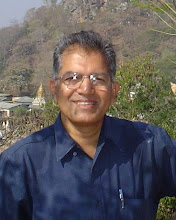
I had hoped to spend a year of contemplation and gardening, or contemplative gardening. It has turned out differently: there is not much contemplation and no gardening. So what have I been busy with? The De Smet book, mainly. Not a very creative enterprise, but certainly an act of pietas, and also – something that vibes with the ‘ordering’ part of my temperament….
So now I have committed to preparing a paper for the June 2009 Lonergan Workshop, but I still find myself drawn to spending time on the next De Smet project: a collection of his Śaṅkara studies. These are many more than the Person studies, but then there is also the experience gathered, and I have the impression that this project will not take me as long as the earlier one. Still, it is taking time, swallowing up time.
For the Workshop I decided to extend my introduction to the Brahman and Person book. I take up De Smet’s ‘retrieval’ or ‘generation’ of the category of person in Indian thought, and see what can be made of it within Lonergan’s method. This would entail, perhaps, studying Lonergan – not so much because I need to study Lonergan, but because I would need to transpose ‘person’ into categories drawn from interiority. The prime candidate for the transposition is ‘subject’, but subject does not quite have the concreteness of person, and that is a problem which I must study. – So I expect De Smet to provide an example of the generation of categories; or else it would be an instance of ‘studies of interiority’ in other traditions (part of the generation of special theological categories). And I would be ‘retrieving’ De Smet’s work from a methodological standpoint.
Something similar might happen w.r.t. his Śaṅkara studies, though perhaps there we would be entering doctrines or perhaps systematics. For where would creation fit? Or better, where would Śaṅkara’s thinking on creation fit? Śaṅkara is a śrutivādin, as De Smet has insisted. He is probably doing systematics, then.
And what about the famous Bibliography of Indian Christian Writings project? Even the promised contributions have not yet materialized. But I would need to spend perhaps a day going through the work of Hambye, and that of Kaj Baajo, and the bibliographies produced by the Heras Institute. That might give me a scheme, at least for the ancient authors, say up to the 19th century. The 20th century would be a very vast enterprise, and that too could be broken up conveniently into pre- and post-conciliar periods.
And then there is the journal, and the nitty-gritty of classes and theses. I have enjoyed doing Aesthetics, and in the bargain have discovered that the reading method – together with a sidelong bow to Montessori’s insistence on the data, the experience – is excellent for arousing, evoking, and holding the attention of the students. What has been amazing also is that they have managed, first years as they are, to follow the philosophers in some way up to Heidegger. Managed is not to say that there has been deep or profound philosophizing – but they have not been turned off, I have not seen anyone drowning, and that itself is very good. Plato coming alive, and also Heidegger…. What more could one want.
But contemplative leisure is important for truly reading, and understanding, and thinking, and creating. Heidegger’s Holzwege arise upon years and years of such contemplative thinking. One has to spiral into the meaning of an author, rise up to his level, so that then one can understood as he has understood and with him. One has to learn to read. And for that one has to slow down. And one begins by walking slower, doing one thing at a time, not cribbing time for prayer, and also playing – which does not mean only football and basketball, but the engaging with the other – the other person, the other kind of book, the newspapers and the magazines and the movies and the novels too.
Sunday, 15 February 2009


Phenomenology of money
We have been reading, in the Aesthetics course, Heidegger’s comments on the work of art. Yesterday we read his amazing phenomenology of a pair of peasant shoes, with the help of a painting by Van Gogh. Today we hope to read his phenomenology of the Greek temple. Where shoes relate earth and the world of the peasant, the temple sets up, founds, a world…
In a dream of the morning, a phenomenology of money: money which is almost totally constituted by meaning.
What kind of world does a 50 rupee note set up?
A 50 rupee note does not get used up, the way a pair of shoes gets used up. When a pair of shoes is used up, it becomes useless, and is reduced to stuff. But when a 50 rupee note is torn, I can ‘redeem’ its ‘value’ through a bank. The wear and tear on its material is immaterial to its value. It is only incidentally material.
So money is different from a pair of shoes. It is an element of society and social arrangements. It has little to do directly with earth, sky, water, air. Or it has to do ultimately with these things, with food for my table, with clothing, with shelter, with roti-kapda-makaan, but as a means. It is part of the division of labour set up by all communities except the most primitive. It is what makes Heidegger possible, for it sets Heidegger free for the task of thinking. Heidegger does not have to plough the ground, wait for the harvest, gather the grain, take it to the mill, knead the flour, bake the bread.
And what might we make of Jesus’ reply, “Give to Caesar what is Caesar’s, and to God what is God’s?”
Does he not imply that, since the Pharisees possess a coin with Caesar’s image, they have accepted to be part of the world which that coin sets up? And is not his reply deliciously ambiguous? For what really is Caesar’s, that has not been given to Caesar by God? “You would not have power over me if it had not been given to you from above.”
In a dream of the morning, a phenomenology of money: money which is almost totally constituted by meaning.
What kind of world does a 50 rupee note set up?
A 50 rupee note does not get used up, the way a pair of shoes gets used up. When a pair of shoes is used up, it becomes useless, and is reduced to stuff. But when a 50 rupee note is torn, I can ‘redeem’ its ‘value’ through a bank. The wear and tear on its material is immaterial to its value. It is only incidentally material.
So money is different from a pair of shoes. It is an element of society and social arrangements. It has little to do directly with earth, sky, water, air. Or it has to do ultimately with these things, with food for my table, with clothing, with shelter, with roti-kapda-makaan, but as a means. It is part of the division of labour set up by all communities except the most primitive. It is what makes Heidegger possible, for it sets Heidegger free for the task of thinking. Heidegger does not have to plough the ground, wait for the harvest, gather the grain, take it to the mill, knead the flour, bake the bread.
And what might we make of Jesus’ reply, “Give to Caesar what is Caesar’s, and to God what is God’s?”
Does he not imply that, since the Pharisees possess a coin with Caesar’s image, they have accepted to be part of the world which that coin sets up? And is not his reply deliciously ambiguous? For what really is Caesar’s, that has not been given to Caesar by God? “You would not have power over me if it had not been given to you from above.”
Sunday, 8 February 2009
Tommaso Demaria, Salesian philosopher
From Mauro Mantovani, I have just heard the name of Tommaso Demaria, a Salesian philosopher-theologian who undertook to integrate history, culture and meaning into metaphysics. Several conferences have been held on Demaria's work in the last 10 years or so, but none of his works have been translated into any other language. The article that Mantovani has contributed to Divyadaan: Journal of Philosophy and Education might well be the first in the English language - but that has to be checked out.
It would be interesting to compare Demaria's effort with that of Lonergan. Demaria explicitly appeals to the Pauline theology of the Body of Christ, our incorporation as baptized members into the Church; and he notes that this incorporation and our action within the Church is historical. History, in other words, is the theorem relevant to ecclesiology, as Lonergan used to say.
It would be interesting to compare Demaria's effort with that of Lonergan. Demaria explicitly appeals to the Pauline theology of the Body of Christ, our incorporation as baptized members into the Church; and he notes that this incorporation and our action within the Church is historical. History, in other words, is the theorem relevant to ecclesiology, as Lonergan used to say.
Saturday, 7 February 2009
Mission and Apologetics
This is a particularly brilliant new opening for Christian mission:
Here we could of course ask ourselves: how exactly might we 'aid others'? How could we be of help?
And again: what exactly is the 'rest of their living'? Could that 'rest' be as large as the world? And what would it mean to integrate the gift of God's love in contemporary India? The question of how we relate to other groups and to the world arises inevitably. There is an inevitably boundary-breaking component in any apologetic task.
In religious matters love precedes knowledge and, as that love is God's gift, the very beginning of faith is due to God's grace. On this showing, not only is the ancient problem of the salvation of non-Christians greatly reduced, but also the true nature of Christian apologetic is clarified. The apologist's task is neither to produce in others nor to justify for them God's gift of his love. Only God can give that gift, and the gift itself is self-justifying. People in love have not reasoned themsleves into being in love. The apologist's task is to aid others in integrating God's gift with the rest of their living. Any significant event on any level of consciousness calls for adjustments elsewhere. (Lonergan, Method in Theology 123, cited in Lovett, For the Joy Set Before Us 206 n 23)God's gift is given - to all. It is not our job as Christians to produce that gift or to justify it, much less to tell people that we alone have been privileged to receive it. But it is our job to be able to recognize it. And it is our job to aid others to integrate that gift with the rest of their living.
Here we could of course ask ourselves: how exactly might we 'aid others'? How could we be of help?
And again: what exactly is the 'rest of their living'? Could that 'rest' be as large as the world? And what would it mean to integrate the gift of God's love in contemporary India? The question of how we relate to other groups and to the world arises inevitably. There is an inevitably boundary-breaking component in any apologetic task.
Thursday, 29 January 2009
Wittgenstein and Lonergan
The variety and profusion of language games: cf. the varieties and profusion of common sense. there are as many type of common sense as there are places and times; and common sense is the ordinary context within which we live and work. And of course it is not static.
Wittgenstein's 'certainties' which form the 'framework': cf. beliefs. Common sense is largely inherited. We add to it our own personal judgments - but even here there is a complex symbiosis between what we discover for ourselves and what is inherited...
Wittgenstein's 'certainties' which form the 'framework': cf. beliefs. Common sense is largely inherited. We add to it our own personal judgments - but even here there is a complex symbiosis between what we discover for ourselves and what is inherited...
Kant, Schiller, Hegel
Kant: pure beauty is non-representational, because representational art is related to a concept. Thus the beauty of a man is not pure beauty, but dependent or adherent beauty. But music without words is pure beauty.
Schiller works out the relationship between beauty and the moral life. In sharp contrast to Plato, he holds that art and beauty can be conducive to the moral life.
Hegel agrees with Schiller, but goes further in pointing out that art is the representation / embodiment / manifestation of the Idea, part therefore of the objective Geist unfolding through history. But art is the lowest type of self-manifestation of the Idea, manifesting the Idea at the level of sense; higher than art is religion, which manifests the Idea at the level of myth and story; and the highest (and this is pure Hegel) is philosophy.
Further, once the Idea embodied in art has been expressed or articulated in a philosophical way – and Hegel has done that – there follows the death of art.
Schiller works out the relationship between beauty and the moral life. In sharp contrast to Plato, he holds that art and beauty can be conducive to the moral life.
Hegel agrees with Schiller, but goes further in pointing out that art is the representation / embodiment / manifestation of the Idea, part therefore of the objective Geist unfolding through history. But art is the lowest type of self-manifestation of the Idea, manifesting the Idea at the level of sense; higher than art is religion, which manifests the Idea at the level of myth and story; and the highest (and this is pure Hegel) is philosophy.
Further, once the Idea embodied in art has been expressed or articulated in a philosophical way – and Hegel has done that – there follows the death of art.
Tuesday, 27 January 2009
Kant on aesthetics
We have been reading selections from Kant's Critique of Judgment, his third critique.
It is wonderful to see the greats in action, in the first person: far better than the summaries in the histories of philosophy.
In the third critique, Kant is sharp, and also provocative at times.
Sharp: the distinctions he makes between the beautiful, the agreeable, the good. He defines beauty in terms of the feeling of pleasure, but carefully distinguishes it from the agreeable and the good. The agreeable is pleasure coupled with interest, he says. Again, we do delight in the good, but the good is connected with a concept and with interest, and beauty has to do neither with concepts nor with interest.
Provocative: he finds beauty only in form, which he subdivides into design and play. Colours, for example, and the quality of sounds, are merely charming; they do not pertain to beauty. Again, a man, or a woman, cannot be called beautiful, simply because the human form is linked to a concept of how that form should ideally be...
So Kant is against representational art, or rather, he considers representational art as 'dependent beauty', simply because it is linked to a concept, to something that it should ideally be, to a telos. Non-representational art - music without words is a prime example - is, instead, 'pure beauty', not linked to any concept.
It is wonderful to see the greats in action, in the first person: far better than the summaries in the histories of philosophy.
In the third critique, Kant is sharp, and also provocative at times.
Sharp: the distinctions he makes between the beautiful, the agreeable, the good. He defines beauty in terms of the feeling of pleasure, but carefully distinguishes it from the agreeable and the good. The agreeable is pleasure coupled with interest, he says. Again, we do delight in the good, but the good is connected with a concept and with interest, and beauty has to do neither with concepts nor with interest.
Provocative: he finds beauty only in form, which he subdivides into design and play. Colours, for example, and the quality of sounds, are merely charming; they do not pertain to beauty. Again, a man, or a woman, cannot be called beautiful, simply because the human form is linked to a concept of how that form should ideally be...
So Kant is against representational art, or rather, he considers representational art as 'dependent beauty', simply because it is linked to a concept, to something that it should ideally be, to a telos. Non-representational art - music without words is a prime example - is, instead, 'pure beauty', not linked to any concept.
Subscribe to:
Posts (Atom)